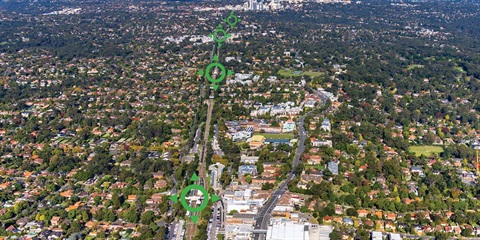
2026 will see the beginning of the dramatic transformation of Ku-ring-gai from a place of trees to a place of to concrete, high rise, traffic gridlock and environmental and heritage degradation.
One of the main reasons touted for the State Significant Developments (SSDs) targeting our suburbs is the lack of affordable housing for essential workers and low wage earners.
However, the majority of developments are not only marketed as luxury units, but many are being sold to overseas buyers, with a historically high proportion being left vacant.
Our Federal Government cites the need for overseas investment to improve housing supply, but the real result is that it has pushed up house and apartment prices as a result of increased demand. Resulting in both house price inflation and rent inflation with no benefit to Australians.
The Federal Government has banned foreign investors, including temporary residents, from buying existing residential property for 2 years until 2027. Of course this is irrelevant as the majority of our suburbs are being inundated with new highrise apartments.
The restrictions to prohibit purchases of existing properties is completely irrelevant as established residences are being purchased and demolished for new residences in order to meet this requirement.
Often foreign residential investment is deemed as insignificant, at 2% of Australian housing stock, however this obscures the fact that purchases by foreign investors are predominantly in Sydney and Melbourne, and usually concentrated in certain Local Government Areas, such as Ku-ring-gai. Accurate figures are difficult to obtain, however Sydney CBD, coastal areas such as Manly, eastern suburbs and the north shore are heavily targeted. In these areas the proportion of homes being purchased by foreign investors can be up to 15% or more.
Foreign investors have definitely added to already high housing demand.
This is not just an Australian problem.
In January 2025, the Canadian government voted to extend their ban on foreign investment of residential property for another two years. Canada had exhibited similar problems with housing affordability and low vacancy rates post-Covid as Australia. One of their solutions was to ban foreign residential investment in January, 2023 for two years. This has now been extended. Why? Because this action was seen as significantly assisting in reducing demand and hence reducing house prices.
The Canadian Government Finance Minister stated “By extending the foreign buyer ban, we will ensure houses are used as homes for Canadian families to live in and do not become a speculative financial asset class.”
The NAB Residential Property Survey Q2 2025, asurvey of around 250 property professionals, highlighted a continuing strong market for Australian residential property by foreign residents.
In new home markets, foreign buyer activity share in NSW has remained unchanged (10.8% vs 11% previous quarter) and continues above the survey average (8.7%).
For the established home market, there was a moderate increase in share in the June quarter (3.3% vs 3.1% previously).
Allowing our increasing scarce housing stock to be bought by foreign investors as an investment, will only ensure additional demand driven housing price inflation. This is to the detriment of all those seeking to rent or as owner-occupiers.
Time to contact your Federal Member of Parliament and demand a stop tp Foreign Residential Property investment in the middle of a housing crisis.
The Minns Government has announced it will sell Hillview Community Health Centre, 1334 Pacific Highway, Turramurra by selling this 10,000m2 heritage conservation site to private property developers. This land was purchased by the NSW Government in the 1970s for strategic health, road and transport reasons. We need this open space/heritage site/ community facility more than ever!
Write to Chris Minns at: https://www.nsw.gov.au/nsw-government/premier-of-nsw/contact-premier
Left to right: Sharon Franke, Bendigo Bank Community Development Manager, Janine Kitson, FOKE Vice-President and Christiane Berlioz receiving the $1000 from the Staff and Grants Nights.
2025 has been a very productive year for the Ku-ring-gai GeoRegion project that highlights Ku-ring-gai’s region for its world class geology, significant flora and fauna and cultural heritage.
The Centre for Public Integrity is concerned about the Federal Government rushing through their environment bill – but with significant integrity issues and no regard for proper legislative process
Read FOKE’s letter to the Mayor of Ku-ring-gai Cr Christine Kay, regarding her media release ‘Council votes to discontinue legal action against the State of NSW, 19.11.25
FOKE expresses disappointment in Council abandoning its legal action against the NSW Government and approving its TOD Alternative Plan (with NSW Government Amendments).
Despite the enormous importance of having this decision debated in open forum, the Councillors made the decision ‘behind closed doors’.
That Council notes that Council’s adopted alternative Transport Oriented Development scheme was largely implemented by the Department of Planning, Housing and Infrastructure on the 14 November 2025 by State Environment Planning Policy Amendment Ku-ring-gai Station Precincts 2025 ensuring:
i. the protection of heritage ii. preservation of biodiversity and tree canopy iii. protection of the desired future character of Ku-ring-gai iv. revitalization of its Town Centres
While Council considers it has strong prospects of having the TOD SEPP declared invalid in its proceedings against the State of NSW, it appreciates that even if it were successful the proceeding themselves would not have led to the outcomes that Council has now been able to achieve.
While Council acknowledges that the transitional provisions associated with State Significant Developments will not resolve satisfaction, this alone would not justify the continuation of the proceedings in all the circumstances.
That Council accept the offer the State of NSW that the current proceedings in the Land and Environment Court be discontinued on the basis that each party bear its own cost. The discontinuous be filed at Court with the consent of the State within one business day of the amended maps being published on the spatial viewer in the same form that those maps were provided to Council last week.
Ku-ring-gai Council has resolved to discontinue the legal challenge to the NSW Government’s Transport Oriented Development (TOD).
At its 18 November meeting, Council unanimously resolved to accept the Government’s offer to discontinue proceedings in the Land and Environment Court.
This follows the decision by the Department of Planning, Housing and Infrastructure earlier this month to implement Council’s alternative TOD scheme.
Ku-ring-gai Mayor Christine Kay said the decision brought certainty to property owners in Gordon, Killara, Lindfield and Roseville.
“Our alternative plan will replace the Government’s former TOD policy and protect important built heritage and tree canopy, while meeting the Government’s targets for new housing in Ku-ring-gai,” Mayor Kay said.
“While there were strong prospects of the TOD SEPP being declared invalid in the Land and Environment Court, this outcome is even better than what could have been achieved if Council was successful in the court proceedings.
“Council’s alternative plan was developed after extensive community consultation and has several advantages over the NSW Government’s TOD. It will help deliver much-needed new housing in a way that responds to community concerns and Ku-ring-gai’s unique area.”
Council resolved to accept the offer of the State of NSW that the current proceedings in the Land and Environment Court be discontinued on the basis that each party bear its own costs.
The discontinuation will be filed at Court, with the consent of the State, within 1 business day of the amended maps being published online.
Council noted that the alternative TOD scheme ensures the protection of heritage, preservation of biodiversity and tree canopy, protection of the desired future character of Ku-ring-gai and revitalisation of town centres.
Council acknowledged that the transitional provisions associated with state significant development were not resolved to its satisfaction but determined that this alone would not justify the continuation of legal proceedings.
Why did Ku-ring-gai Council vote on their Alternative TOD plan – one of the most important planning decisions for Ku-ring-gai’s future in CONFIDENTIAL?
still wants to keep the State Significant Developments?
includes the rezoning of additional heritage properties at 12 Stanhope Road, Killara; 9 Middle Harbour Road and 1 Valley road Lindfield; 29 Roseville Ave
off loads affordable housing to Council but lets developers ‘get out of affordable housing’ after 15 years
Major additions/ uplifts for No. 1-7 Carlotta Avenue, Gordon, and no.1A Carlotta Avenue, Gordon. This will now be zoned for 29m, and 1.8:1 FSR
Major additions/ uplifts for Nos. 9, 15 and 17 Dumaresq Street, Gordon. Height of building (HOB) from 51.5m to 64.5m
Major additions/ uplifts for Nos. 784, 786-788, 788A, 790, and No.802-808 Pacific Highway, Gordon (the Gordon Centre) Height of Building (HOB) increase from 93 to 109 m, FSR inc from 6.5:1 to 7.5:1. Minimum site area reduced from 9000m to 7700
Major additions/ uplifts for No. 22 Bent St and nos. 2, 4, 6, 8, 10, 12, 14, 16 & 18 Newark Crescent, Lindfield FSR increase from 0.85:1 to 1.3:1 to match neighbouring propoerties one side of this crescent. With increased HOB from 12m to 18.5m
Major additions/ uplifts for No. 5 Oliver Rd and 4 Roseville Ave, Roseville. As I understand the subclauses on this. This area behind Hill st Roseville is affected by some clauses that I think mean they can be included in any SSD. Very confusing language
924 Pac Hwy Gordon. Height up from 51.5 to 61m
No. 810 Pacific Highway, Gordon, HOB increase from 70.5 to 73.5
No. 2 Spencer Road, Killara FSR increase from 0.85:1 to 2.1:1
No. 345 Pacific Highway, Lindfield HOB increase from 51.5 to 54m
Nos. 239, 251, 257, 259, 265-271, 283, 295-303, 305-309, 313, 317, 321, 323, 329 Pacific Highway and Nos. 1-5 Tryon Place, Lindfield HOB increase from 51.5 to 54m (This is the current Lindfield Library site all the way to the station)
Some additions, some removals for active street frontage maps
A key reason for the Minns Government’s overhaul of the NSW environment and planning laws is not for communities, not for good affordable housing, not for climate resilience but for the mining and development industry and their super profits.
Minns candidly told a Sydney Investment Summit in October 2025 that he is keen to make NSW ‘the quickest, the easiest, the most direct state to develop and release big projects in’.
He also told an international mining summit that he wants ‘quicker approvals and quicker productive mines.’
Minns constant messaging has been that the Environmental Planning and Assessment Amendment (Planning System Reforms) Bill 2025 is about making it easier to build more mid-high rise apartments everywhere, regardless of thei9r environmental damage. Now Premier Minns has admitted that the new Bill will also apply to mining and power projects.
Despite NSW Labor’s rhetoric about being a party ‘better for the environment’ their planning legislation fails for climate action and biodiversity protection. Minns new laws will remove, weaken and obliterate controls to ensure a safe climate and accelerate biodiversity extinction.
Jeremy Buckingham MLC moved a last-minute amendment in the Legislative Council on Thursday 23 October 2025 calling for climate impacts and greenhouse gas emissions to be considered when assessing developments.
Write to your local MP calling on her/him to support this amendment when it is debated on Tuesday 11 November 2025.
Read more:
Nature Conservation Council of NSW E-News Minns’s plan to fast-track mining projects exposedHERE
Biggest rollback of planning protections in NSW history
The Minns Labor Government has introduced one of the largest rollbacks of planning, environment and community protects since 1979 with the first Environment Planning Assessment Act. Its new Environmental Planning and Assessment Amendment (Planning System Reforms) Bill 2025 is a seismic change for NSW citizens in how development will affect planning and environment decisions in every local government area of NSW.
What does the Environmental Planning and Assessment Amendment (Planning System Reforms) Bill 2025 do?
removes health and safety from the Objects of the Act
removes health and safety from the objects of the Act
weakens the duty to consider environmental impacts,
creates new fast-track approval pathways where decision-makers are prohibited from weighing the environment, climate impacts or the broader public interest.
centralises power in a single senior executive, the Planning Secretary, at the expense of councils, independent agencies, and communities.
Why is the Bill so dangerous?
“This Bill is the most dangerous change to our planning system we have ever seen. The Government is using the housing crisis as cover to ram through reforms that silence communities, weaken environmental protections and hand extraordinary power to one bureaucrat”- Greens MP, Spokesperson for planning Sue Higginson (3.10.25)
“Protections for the environment are being stripped out across the Act. The duty to consider impacts on land, water, biodiversity and climate has been replaced with a proportionality test, allowing obligations to be watered down. At the same time, the Bill makes it possible that considering climate impacts under the public interest test could be deemed unlawful. These are not reforms for the future, they are a deliberate weakening of our ability to plan responsibly in a climate and extinction crisis”- Greens MP, Spokesperson for planning Sue Higginson (3.10.25)
“The Bill also removes the requirement for bushfire hazard assessments, leaving communities more vulnerable at a time when fire risk is intensifying across NSW”- Greens MP, Spokesperson for planning Sue Higginson (3.10.25)
“Community participation will be gutted. Local participation plans will be abolished and replaced with a single statewide plan controlled by the Planning Secretary. The result will be cookie-cutter consultation that ignores the specific needs and knowledge of local communities”- Greens MP, Spokesperson for planning Sue Higginson (3.10.25)
“The Bill also undermines the protection of First Nations cultural heritage and Country. By funnelling approvals into the Development Coordination Authority, expert advice from Heritage NSW and the voices of Land Councils and Native Title holders will no longer be guaranteed a statutory role in decision-making”- Greens MP, Spokesperson for planning Sue Higginson (3.10.25)
“This is not planning reform. It is a developer’s charter. It will open the door for damaging projects to be forced onto communities, strip out safeguards for biodiversity and climate, and put people at greater risk from fire and unsafe development”- Greens MP, Spokesperson for planning Sue Higginson (3.10.25)
“All Members of Parliament who truly represent their communities should oppose this Bill. We need planning reform that tackles the housing crisis while strengthening, not dismantling, protections for communities, the environment and First Nations heritage” M- Greens MP, Spokesperson for planning Sue Higginson (3.10.25)
Read what Sue Higginson MLC has to say about the Environmental Planning and Assessment Amendment (Planning System Reforms) Bill 2025 HERE
FOKE Summary
The Minns Labor Government has introduced the Environmental Planning and Assessment Amendment (Planning System Reforms) Bill 2025. The Bill represents one of the largest rollbacks of planning, environmental and community protections since the Planning Act was introduced in 1979.
The Bill removes health and safety from the objects of the Act, weakens the duty to consider environmental impacts, and creates new fast-track approval pathways where decision-makers are prohibited from weighing the environment, climate impacts or the broader public interest. It centralises power in a single senior executive, the Planning Secretary, at the expense of councils, independent agencies, and communities.
Greens MP, Spokesperson for planning Sue Higginson said:
“This Bill is the most dangerous change to our planning system we have ever seen. The Government is using the housing crisis as cover to ram through reforms that silence communities, weaken environmental protections and hand extraordinary power to one bureaucrat,”
“Protections for the environment are being stripped out across the Act. The duty to consider impacts on land, water, biodiversity and climate has been replaced with a proportionality test, allowing obligations to be watered down. At the same time, the Bill makes it possible that considering climate impacts under the public interest test could be deemed unlawful. These are not reforms for the future, they are a deliberate weakening of our ability to plan responsibly in a climate and extinction crisis,”
“The Bill also removes the requirement for bushfire hazard assessments, leaving communities more vulnerable at a time when fire risk is intensifying across NSW,”
“Community participation will be gutted. Local participation plans will be abolished and replaced with a single statewide plan controlled by the Planning Secretary. The result will be cookie-cutter consultation that ignores the specific needs and knowledge of local communities,”
“The Bill also undermines the protection of First Nations cultural heritage and Country. By funnelling approvals into the Development Coordination Authority, expert advice from Heritage NSW and the voices of Land Councils and Native Title holders will no longer be guaranteed a statutory role in decision-making,”
“This is not planning reform. It is a developer’s charter. It will open the door for damaging projects to be forced onto communities, strip out safeguards for biodiversity and climate, and put people at greater risk from fire and unsafe development,”
“All Members of Parliament who truly represent their communities should oppose this Bill. We need planning reform that tackles the housing crisis while strengthening, not dismantling, protections for communities, the environment and First Nations heritage,” Ms Higginson said.
Read FOKE’s analysis of the final debate on the Environmental Planning and Assessment Amendment (Planning Systems Reform) Bill 2025 on Thursday 24 October 2025
Read FOKE’s letter sent to Members of the NSW Legislative Council (MLCs) CROSSBENCH asking them to vote AGAINST Labor’s Environmental & Planning Laws, 20 October 2025
Read more about this question in the Sydney Morning Herald article From leader to lobbyist: How Morris Iemma opens doors for Sydney Property Developers by Michael McGowan, 18 October, 2025
Read FOKE’s letter to NSW Liberal Mr Scott Farlow, Shadow Planning Minister who can make a difference if he votes against NSW Labor in the Upper House on Tues 21 October 2025
Read FOKE’s letter sent to Members of the NSW Legislative Council (MLCs) CROSSBENCH asking them to vote AGAINST Labor’s Environmental & Planning Laws, 20 October 2025
Read FOKE’s letter to the Crossbench asking them to vote against the Environmental Planning and Assessment amendment (Planning Systems Reforms) Bill 2025.
NSW Labor is a minority government. It relies on the vote of ONLY ONE Crossbench to pass its legislation. Maximum pressure needs to be put on the Crossbench. Write your letter opposing the Planning Bill now.
Read FOKE’s draft Mayoral Minute to honour Graham Lewis (1941-2025) former FOKE member, Vice-President of the Ku-ring-gai Preservation Trust (KPT) and long term supporter of Ku-ring-gai’s heritage and environment.
In March 2024 FOKE’s submission to the Inquiry into Development of the Transport Oriented Development (TOD) Program was made ‘partially confidential’. Why?
Because FOKE dared suggesting that the NSW Government’s planning reforms risked NSW returning to ‘a corruption state’.
Now journalist Michael Sainsbury has published the article Back to Obeid? Fast-track housing laws a stalking house for fast-track mines. He, asks whether NSW could return to the Obeid days with the new fast-track planning laws for ‘housing’ and which give the NSW Planning Minister unprecedented approval powers.
Despite the Minns Government consulting with ICAC (Independent Commission Against Corruption) it seems that they are silent at this stage. The new planning laws will concentrate power in the Planning Minister (Mr Paul Scully) and the Secretary of the NSW Planning Department (Ms Kiersten Fishburn).
Many remember how this was when the last Labor Planning Minister Ian Macdonald used similar powers through the then known controversial Part 3A of the Environmental Planning and Assessment Act. When the Liberals were elected in 2011 one of the first things they did was overturn the controversial Part 3A of the Environmental Planning and Assessment Act.
The new Planning System Reform Bill (2025) appears to fast-track all development for approval.
Sue Higginson, Greens MLC has expressed strong concern that the planning reforms, despite the claim they are there to address the housing affordability, will have huge ramifications of the entire NSW planning system – particularly with mining proposals.
Few would guess the changes to the planning act have their origin in unlocking mining approvals and not housing, which Minns and Scully spruke.
The justification to modernise the NSW planning system is now an excuse to fast tracking development and abandon environmental protection.
The Bill proposes to enshrine into Legislation the controversial Housing Delivery Authority, the Investment Delivery Authority and the Development Co-ordination Authority.
ICAC legislation encourages the Government to consult with them when introducing new laws but the government can chose not to take ICAC’s advice.
The new laws have kept the public in the dark. Ther has been no parliamentary or public consultation with communities. The Liberal Party has expressed support for the Bill.
It is believed that the motivation for the new legislation has arisen because a new mine was rejected by the NSW Court of Appeal.
It is also understood that Silver Mines Limited has had seemingly unfettered access to the NSW Government and who receive strong support of Ministers to get their project back on track.
The CEO of Silver Mines, Jo Battershill, in an address to the Beaver Creek Precious Metals summit, has said publicly that ‘Silver Mines has the full support of the NSW Government’.
The Sydney Retired Unionists Group are deeply concerned about the systemic problem of powerful vested interests capturing government. Is this what is happening now with the NSW Planning laws?
Please write to not only your local MP but also the Opposition Leader Mark Speakman and Premier Chris Minns.
The housing crisis is now being used as blatant propaganda to legitimise sweeping changes to the Environmental Planning and Assessment Act (1979). The changes will shift the focus from protecting community and environmental well being to promoting development and productivity. It will remove remove safeguards for threatened species, ecological communities, heritage and the public interest.
NSW Liberal leader Mark Speakman has now declared he supports Labor’s new planning laws that allow developers to get what they want – demolish and rebuild Sydney without controls to protect the environment and heritage.
The new law will even make it unlawful to consider environmental harm.
Members of FOKE attended a developers’ forum recently where they witnessed Mark Speakman proudly saying he was now a “Yimby” and fully behind Labor in their agenda to support developers at whatever cost.
Already Ku-ring-gai’s planning has been undermined by the NSW Govenrment’s pop up State Significant Developments (SSDs). Ku-ring-gai Council’s planning controls have been undermined by the NSW Government’s Housing Development Authority (HDA) that overrides its powers and local democracy. Now they want to completely deregulate the planning system in favour of developers.
FOKE opposed the State Significant Development at 16-20 Middle Harbour Road Lindfield (SSD83431958) because:
Is not compatible with the desired future character of Lindfield.
Fails to comply with KLEP 2015, KDCP, SEPP (Housing) 2021 and ADG standards.
Overshadows and overwhelms neighbourhood properties and dominates heritage listed properties.
Has inadequate setbacks, building separation and visual privacy.Impacts on the development potential of adjoining sites.
Impacts on waterflows and flooding across numerous sites.
Has inadequate solar access to dwellings and inequitable solar access to affordable housing.
Has inadequate deep soil zones for planting canopy trees.
The State Significant Development Application proposals at 16-20 Middle Harbour Road are not compliant in height, setbacks and should be rejected as it will have a negative and detrimental impact on local heritage, environment, traffic, urban design, neighbourhood character, visual amenity, liveability, tree canopy, open space, infrastructure, and community benefit. As such the SSD proposal should be rejected
“In terms of the environment and social justice, this generation is different. They hear about the climate crisis and increasingly about the social crisis. Young people are better equipped than we were to understand and deal with the problems we have created,” says Jane Goodall.
Following the NSW Liberal Party’s 2023 election loss, Opposition Leader Mark Speakman has announced he is repositioning the party as “unashamedly YIMBY” (Yes In My Backyard) as his reason for addressing NSW’s housing crisis.
In a speech to the Housing Now conference, a pro-housing alliance, Speakman emphasised the urgent need for more housing to prevent younger generations from being locked out of homeownership.
Speakman highlighted the party’s soul-searching post-election, noting its lack of appeal to voters under 35, who favor Labor and the Greens. He believes an aggressive pro-housing stance, inspired by Canadian conservatives, can reverse this trend. On immigration, a key driver of housing demand, he suggested recalibrating its composition to avoid undermining construction by limiting skilled tradies.
He criticised the NSW government for abandoning new Metro station plans, promising a Liberal Metro policy before the next election.
Speakman, in general, supported the government’s planning reforms and the Woollahra station redevelopment, though he doubted the projected 10,000-home uplift.
He also urged waiving certain housing taxes during the National Housing Accord period and prioritizing greenfield developments, as the state is set to miss its housing targets.
Read full article HERE
Mark Speakman says . .
He is “Unashamedly YIMBY”
He believes the reforms will be “overwhelmingly good for neighbourhood homes”
He supports “more infill housing and more greenfield development”
He supports “ densification round rails stations”
He believes that NSW “is not fulfilling the housing need fast enough”
He is wanting to be “constructive in opposition”
He “broadly supports majority of the proposals”
The Libs are working with Labor “ in bipartisan round table discussions”
He believes NSW is “desperate for planning reforms”
He will be “taking the reforms he supports to the party room”
He wants the Libs “to at least support the vast package of reforms”
He supports the introduction of a “Development authority”
He is “disappointed in the number of housing approvals in NSW”
He said that “infill and greenfield development is not feasible due to taxes and charges”
He said he was” supportive of the Rosehill development and that they (Libs) would be looking at Rosehill”
He believed “there is great opportunity to develop Long Bay Jail”
He is “supportive of the proposed development of the Woollahra rail station and the addition of 10,000 dwellings”
He said “we wants to be constructive and reforms on all fronts to make housing more affordable”
HE said the Libs “are coming 3rd behind Labor and Greens and the way to reverse that is to be pro-housing”
He wants to see a “One Stop Shop to streamline development”
He wants to see “ Greater density round major hubs”
He is happy for “deferring developer contribution payments until occupancy stage”
He wants “to see reduced land tax for rent to build developments”
He Is not seeing “ enough planning round schools and hospitals”
He wants “to see Stamp Duty reform”
He wants to see a “downsize contribution for 3 bedrooms or more”
He said the Libs “will build more METROS”
He wants the Libs “to be a party of HOPE and reward aspiration – particularly the younger generation as a positivity of force””
Lucy Macken’s Sydney Morning Herald article (7.10.25) describes the pitfalls of developers options
Jennifer Maxwell and ten neighbors in Castle Hill, Sydney, agreed in 2015 to sell their homes as a mega-lot to a developer for $42.25 million, lured by offers significantly above market value due to rezoning and a new metro station.
The deal promised Maxwell $3.43 million to fund her retirement. However, a decade later, only three owners have been paid, leaving Maxwell and seven others in limbo as the developer, Castle 7 Pty Ltd, struggles with planning approvals and funding.
The trust went into liquidation in 2025 with $5 million in debts, halting penalty interest payments.
The article highlights the risks of such deals amid Sydney’s housing reforms, which have spurred mega-lot sales in suburbs like Mosman and Rose Bay.
However, increased site supply has reduced values, and delayed settlements—sometimes years long—can erode the deal’s worth. In Castle Hill, the median house price nearly doubled since 2015, while apartment prices grew only 17%, diminishing the project’s viability.
The syndicate’s unity fractured when some settled early at discounts, and the developer sold the option to another investor.
Despite new settlement offers at reduced prices, Maxwell, now caring for her ailing husband, insists on the original amount.
The article warns homeowners to be cautious of developer promises, especially when zoning and approvals are uncertain, citing a nearby controversial development and the financial collapse of another developer as cautionary examples.
Read SMH article HERE
Why Option Contracts are Detrimental for Homeowners
Low-Cost Land Control: Developers can secure parcels of land at a low cost, gaining the exclusive right to purchase at a minimal price sometime in the future.
Non-Binding for Developers: These contracts are not binding on the developers, allowing them flexibility without immediate commitment.
Binding for Homeowners: Conversely, these contracts are binding on homeowners, limiting their options.
Fixed Purchase Price: The purchase price is locked in at the time of the contract, ignoring potential increases in market value.
Loss of Control: Homeowners lose control over the timing of their property’s demolition.
The combined environmental networks of Ku-ring-gai are appalled at Ku-ring-gai Councillors’ recent decision around the future of Norman Griffiths Oval, West Pymble.
Ku-ring-gai Council invites comment from the community on an amendment to Part 14 of the Ku-ring-gai Development Control Plan (KDCP).
The eight Character Areas formalised in the Council adopted Ku-ring-gai Local Character Background Study are proposed to be inserted at the beginning of Part 14 of the KDCP.
The inclusion of this amendment will mean that the many applications being submitted to Council will have to have regard to local character and the setting of buildings. Improved reference to local character matters will enable better retention of the area’s values, including trees and landscaping, which are key across Ku-ring-gai.
Providing feedback: Mark your comments with the reference number “S14276-2” and include your contact details. Send your comments by email krg@krg.nsw.gov.au; or by mail: General Manager, Ku-ring-gai Council, Locked Bag 1006, Gordon NSW 2072. Comments must be made by 5pm on Monday 1 September 2025.
NSW Planning Minister Paul Scully and NSW Department of Planning staff were questioned at the Budget Estimates on 25 August 2025.
It was a very disappointing to listen to the Minister in denial about the devastation that his ‘reforms’ are going to wreck across Greater Sydney’s heritage and environment.
North Ryde bushland is threatened with a State Significant Development (SSD) that proposes a six-storey data centre for 6-8 Julius Avenue, North Ryde.
The proposal- a major digital infrastructure build with 12 data halls, a 115.2MW IT load, a five-storey office building, and an Ausgrid switching station. T
Visit the NSW Planning Portal‘s major projects section for the Julius Avenue Data Centre project.
You will need to register and log in to the portal to view the full documents and make a submission.
Where is the discussion about the infrastructure costs for the 23,500 dwellings from Ku-ring-gai Council’s ‘Big and Beautiful’ Transport Oriented Development Alternative Plan?
For Ku-ring-gai Council to consider the amendment of the Ku-ring-gai Development Control Plan to include Local Character Areas and endorse its public exhibition.