
Please register to speak at the Council Forum by 5pm SUNDAY 30 March 2025 and then attend this important meeting on MONDAY 31 March 2025 (Public Forum 5-7pm; followed by Council meeting from 7pm).
Continue reading
Please register to speak at the Council Forum by 5pm SUNDAY 30 March 2025 and then attend this important meeting on MONDAY 31 March 2025 (Public Forum 5-7pm; followed by Council meeting from 7pm).
Continue reading
Please register to speak at the Council Forum by 5pm SUNDAY 30 March 2025 and then attend this important meeting on MONDAY 31 March 2025 (Public Forum 5-7pm; followed by Council meeting from 7pm).
Continue readingPlease register to speak at the Council Forum by 5pm SUNDAY 30 March 2025 and then attend this important meeting on MONDAY 31 March 2025 (Public Forum 5-7pm; followed by Council meeting from 7pm).
Continue readingPlease register to speak at the Council Forum by 5pm SUNDAY 30 March 2025 and then attend this important meeting on MONDAY 31 March 2025 (Public Forum 5-7pm; followed by Council meeting from 7pm).
Continue reading
Attend Ku-ring-gai Council’s Extraordinary Council meeting on MON 31 March 2025 5pm to consider TOD preferred scenario
Continue reading
The affordable housing component WILL NOT meet the NSW Government’s affordability definition at $900,000 for an average renter.
Continue readingThe call for a general halt to new construction in the developed world is gaining momentum as the planet faces unprecedented threats and challenges caused by climate crisis, ecosystem collapse and biodiversity loss. The dire ecological impact of the construction industry, both international and domestically is now beyond tenable.
Continue reading
At the Ordinary Meeting of Council held on Tuesday 18 March 2025, Ku-ring-gai Council considered a report on the above matter and resolved the following:
That:
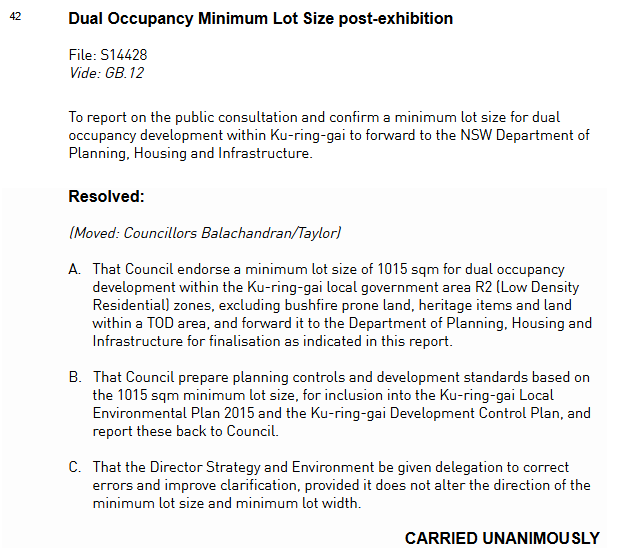
To view the Council report please click here
To view the Council resolution please click here
Read Ku-ring-gai Council Latest News, 19 March 2025: Ku-ring-gai progresses two housing initiatives HERE

Stay in Touch
Sign up for FOKE E-News HERE
info@foke.org.au
https://www.facebook.com/friendsofkuringgai/
If every resident of Ku-ring-gai wrote to Premier Minns he would change his mind
Continue reading
How the HDA works: 1. Expression of Interest; 2. HDA bureaucrats examine details; 3. HDA makes recommendation to Planning Minister; 4. DA lodged; 5. Public display 6. Decision made
Continue reading
FOKE Newsletter, March 2025: Alternative scenarios. What was the point? p1; President’s Message p2; Federal Environmental Issues p3-4; ‘Wild West’ Developer Led Planning for NSW p3; Wahroonga Seniors Living SSD p 3; FOKE Heritage in Peril Walks: Roseville: 26.4.25; Lindfield: 27.4.25; Killara: 3.4.25: Gordon: 4.4.25 p4;
Jan Langley Sustainability Award p4; Jean Posen Environment Award p4

Roseville: SAT 26 April 2025;
Lindfield: SUN 27 April 2025;
Killara: SAT 3 May 2025;
Gordon: SUN 4 May 2025

Find out if you will be affected by a State Significant Applicaiton near you
Continue reading
Deadline for submissions 31 March 2025
Continue reading
Read FOKE’s Submission on the draft Ku-ring-gai Green Grid Strategy due 12.3.25
Continue reading
Hyecorp is proposing a high rise development at 21-27 Roseville Avenue and 16-24 Lord Street, Roseville
The project is a State Significant Development.
The NSW Department of Planning, Housing and Infrastructure (DPHI) is responsible for the
assessment of the application. It will bypass Ku-ring-gai Council planning controls.
When planning, design, and all accompanying technical studies have been completed, a State
Significant Development Application (SSDA) will be submitted to DPHI.
The SSDA and all supporting documentation will be placed on public exhibition for a minimum of 28 days, and members of the community will be invited to make a submission about the proposal.
The SSDA and public submissions will be assessed by DPHI and a determination will be made.
Stay in Touch
Sign up for FOKE E-News HERE
info@foke.org.au
https://www.facebook.com/friendsofkuringgai/

Ku-ring-gai, located in Sydney’s northern suburbs, is renowned for its unique and environmentally sensitive and significant landscape. Often described as the “lungs of Sydney,” this region is characterized by a rich blend of natural and cultural features that set it apart.
Its environment includes lush bushland, a substantial tree canopy, and critically endangered ecological communities, including the Blue Gum High Forest, Sydney Turpentine Ironbark Forest, and Duffys Forest.
Less than 1% of the Blue Gum High Forest remains globally, making its preservation a matter of international ecological importance.
The area is also home to diverse flora and fauna, significant Aboriginal heritage sites, and a distinctive urban forest that contributes to both biodiversity and the region’s aesthetic character. This green environment not only supports local wildlife but also plays a vital role in mitigating urban heat, improving air quality, and maintaining the ecological health of surrounding areas like Western Sydney, the Northern Beaches, and the Hawkesbury River.
The unique character of Ku-ring-gai is further defined by its heritage-listed properties, heritage conservation areas and garden suburbs, which have historically been shaped by a preference for low-density housing and detached homes surrounded by garden. Ku-ring-gai has the best collection of 20th Century domestic architecture in the nation.
For over 30 years Friends of Ku-ring-gai Environment (FOKE) have highlighted the need to preserve Ku-ring-gai’s local identity, character, amenity, heritage and environment. Ku-ring-gai is an integrated blend of both the natural environment and the built suburban form. The Ku-ring-gai Local Strategic Planning Statement and Urban Forest Strategy underscore the commitment to maintaining this balance, aiming to conserve the area’s visual and landscape character amid growth pressures.
However, overdevelopment poses a significant threat to this delicate ecosystem and community fabric.
Current NSW Government planning policies including the Transport Oriented Development (TOD) program mandates higher-density housing (6- to 7-storey apartment buildings within 400 meters of stations like Gordon, Killara, Lindfield, and Roseville). The TOD is seen as a direct challenge to Ku-ring-gai’s environmental and heritage values. Critics argue that such policies override local protections—like the Tree & Vegetation Development Control Plan and heritage conservation measures—will lead to several adverse impacts:
Community resistance, backed by Ku-ring-gai Council’s legal action against the TOD policy, reflects widespread concern. Residents fear property devaluation and the loss of their “green” environment to what they describe as “hyper-overdevelopment.” While the region has already approved 13,000 new dwellings since 2006 and faces a target of 10,660 more by 2036, FOKE has argued that existing zoning cannot accommodate this level of growth without sacrificing the area’s unique attributes. The tension lies in balancing housing needs with the preservation of an irreplaceable natural and cultural legacy—a challenge that remains unresolved.
Stay in Touch
Sign up for FOKE E-News HERE
info@foke.org.au
https://www.facebook.com/friendsofkuringgai/

Read latest FOKE E-News that asks what is the point of alternative TOD scenarios when developers can bypass Ku-ring-gai Council?
Continue readingDevelopers will lodge two State Development rezoning proposals in Gordon and Lindfield with the NSW Government’s Housing Development Authority bypassing Council.
Continue reading
Developers circle around Ku-ring-gai
Continue reading
FOKE is supportive Ku-ring-gai Council’s draft Affordable Housing Policy – but with some
some reservations and concerns.