

Developers are now bypassing Ku-ring-gai Council and have their proposals assessed by the NSW Housing Delivery Authority (HDA). Read more about the HDA HERE
Premier Chris Minns established the HDA in November 2024 to fast track new homes and bypass local councils. The process is undemocratic and prioritises high-density development before environmental, heritage and community concerns.
The process allows developers to apply to have their projects assessed by the HDA. The HDA is a panel of three bureaucrats—Planning De-partment Secretary Kiersten Fishburn, Premier’s Department secretary Simon Draper and Infra-structure NSW chief executive Tom Gellibrand. This panel of bureaucrats are only accountable to the Premier and not the community.
Communities only learn of the proposals when they are contacted by the Department of Planning or the developer.
The HDA will consider Expressions of Interest projects worth more than $60 million. The EOI is then decided by the panel of three if they are to be processed as State Significant Developments. Planning Minister Scully gives the final approval.

Expression of interest
Applicant submits an expression of interest to the HDA, with details about the location, development plan, and affordable housing provisions

Examine details
HDA bureaucrats examine the expression of interest against criteria, including whether construction can begin within 12 months and how the proposal will lead to more housing
Recommendation made
HDA recommends the Planning Minister either approve a pathway as a State Significant Development, a State Significant Development and concurrent rezoning of land, or to go through a regular development application pathway

DA lodged
If an application is a State Significant Development, the applicant has nine months to lodge an official development application (DA) with the Department of Planning, Housing and Infrastructure
Public display
DAs are put on public display and open for feedback as usual

Decision made
The Planning Minister or Department of Planning must decide on a DA within 275 days of it being lodged
FROM: https://www.smh.com.au/interactive/modules/people-gallery-extended/index.html?resizable=true&v=150&configUrl=https://www.smh.com.au/interactive/hub/configs/people-gallery-extended/41404.json&v=0.6011299158538073
Please contact FOKE if you know about a SSD n e a r you at info@foke.org.au
FOKE knows of the following State Significant Development (SSD) Applications on the NSW Government Planning Portal:
- 3-9 Park Avenue, Gordon
- Burgoyne and Pearson Avenue, Gordon
- Woodside & Highgate Road, Lindfield
- 21-27 Roseville Avenue and 16-24 Lord Street, Roseville
- 2-8 Highgate Road, Lindfield
- 27-29 Tryon Road, Lindfield
- 12-16 Bent Street, Lindfield
- 59-63 Trafalgar Avenue 1A & 1B Valley Road, Lindfield
- 2, 4, 6, 8, 10, 12, 14 & 16 Pockley Avenue, Roseville
- 2-4 Larkin Street & 1-5 Pockley Avenue, Roseville
The nine proposals will yield approximately 1100 new homes.
These EOI proposals currently before the Department are for 8-10 storeys. They all have an affordable housing component. They are adjacent to single and two storey homes.
Read Housing Delivery Authority Record of Briefing – 19 February 2025 HERE
The Sydney Morning Herald,
27 February 2025:
Sydney is getting 18 fast-tracked housing projects. James Packer is backing one
ARTICLE by Max Maddison, The Sydney Morning Herald, 27 February 2025
A James Packer-backed development in Surry Hills and a 22-storey tower in Edgecliff are among 18 housing projects fast-tracked by the state government’s new planning authority to deliver more than 8600 dwellings.
The second tranche of proposals considered by the Housing Development Authority, a three-person panel composed of the state’s most senior bureaucrats, were spread across 13 local government areas, including North Sydney, Woollahra, Inner West and Willoughby.
The triumvirate was appointed by Premier Chris Minns in mid-November to accelerate development approval times for major residential developments above $60 million in metropolitan areas and $30 million in regional NSW. More than 15,000 potential homes have been greenlit by the HDA since February 18. They will be subject to an accelerated approval process.
https://www.smh.com.au/interactive/modules/before-after-image-slider/index.html?resizable=true&v=102&configUrl=https://www.smh.com.au/interactive/hub/configs/before-after-image-slider/40540.json&v=0.2947925750173854
Announced on Thursday, the projects included a 1200-dwelling Mirvac development on the corner of Botany Road and Bourke Street in Zetland, a Stockland proposal to build a 50-storey apartment with retail on the Pacific Highway in St Leonards, and 156 luxury apartments including affordable housing in Surry Hills on Marlborough Street. Formerly a David Jones warehouse, the $110 million Marlborough House development by Time & Place is backed by James Packer.
Other projects include a 22-storey residential tower on McLean Street in Edgecliff, adjacent to the station. In late November, developer Longhurst overcame a significant hurdle after a planning panel approved a 35-storey development of the Edgecliff Centre.
|
Of the 39 proposals considered by the housing authority at the February 19 meeting, nearly half were recommended for the fast track, including projects in Bankstown, Hurstville, Gladesville and Macquarie Park. Applications in Lane Cove, Wahroonga and Castle Hill were among 16 projects knocked back.
Minister for Planning and Public Spaces Paul Scully noted the number of potential homes that have been declared state-significant by the housing authority.
“The Minns Labor government established the HDA to reduce the time it takes for proposals to progress through a planning pathway, and it is pleasing to see that the first two HDA meetings have delivered quality proposals that will now develop detailed proposals,” he said.
“The quality of proposals recommended to me by the HDA shows that developers are hearing the message – we’re looking for major housing developments that can get out of the ground quickly.”
The HDA has received more than 200 expressions of interest since January. It comprises Premier’s Department secretary Simon Draper, Planning Department secretary Kiersten Fishburn and Infrastructure NSW chief executive Tom Gellibrand.
The Sydney Morning Herald,
21 February 2025:
Revealed: 171 Sydney spots getting more apartment blocks in pared-down density reform
ARTICLE by Megan Gorrey, The Sydney Morning Herald, 21 February 2025
More terraces and apartment blocks up to six storeys will be allowed around 171 transport hubs and town centres in greater Sydney and surrounds after the NSW government finalised pared back medium-density housing reforms intended to deliver more than 100,000 homes within five years.
Faced with a five-year goal to deliver 377,000 new dwellings in NSW, the government said its long-awaited “missing middle” housing reforms would deliver more terraces, townhouses and small apartment blocks in Greater Sydney, the Central Coast, Illawarra, Shoalhaven and Hunter regions.
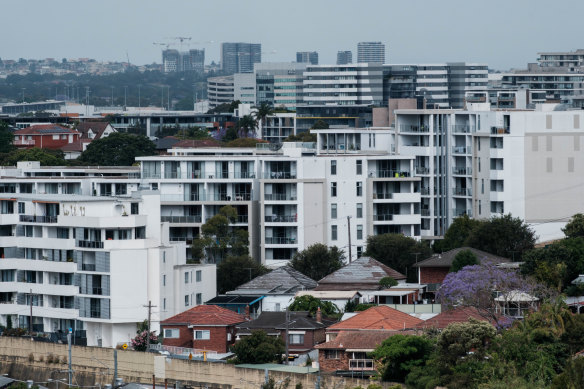
The changes will broadly enable apartment buildings up to six storeys within 400 metres of the chosen sites and blocks up to three storeys within 800 metres in residential zones. They will come into effect on February 28.
Premier Chris Minns said medium-density housing had long played an important role in delivering homes throughout NSW, but most local councils had effectively banned them in recent decades.
“The homes built under these reforms will be close to transport, open spaces and services that people need, creating better connected and more liveable neighbourhoods by making the most of existing critical infrastructure,” Minns said.
The state government announced its medium-density reforms to fill the gap between freestanding houses and high-rise apartments in November 2023. The policy intended to help deliver more than 112,000 homes by mid-2029 and account for about 30 per cent of its National Housing Accord target.
The first stage of the policy, which enabled the construction of dual occupancies and semi-detached dwellings across most of NSW, came into effect in July last year.
But the second stage – allowing more terraces, townhouses and small apartment blocks within an 800-metre radius of transport hubs and town centres –was delayed until after last September’s local government elections following strong pushback from local councils.
The Sydney spots getting more apartment blocks
| Nominated town centres and stations | Local Government Area | |
|---|---|---|
| Arncliffe station | Bayside | |
| Banksia station | Bayside | |
| Bexley North station | Bayside | |
| Rockdale Plaza shopping centre | Bayside | |
| Rockdale station and town centre | Bayside | |
| Turrella station | Bayside | |
| Kogarah station and town centre | Bayside, Georges River | |
| Blacktown station and town centre | Blacktown | |
| Doonside station | Blacktown | |
| Mount Druitt station and town centre | Blacktown |
Source: NSW government
The government later promised the changes would start by the end of 2024. It had been widely expected to scale back the reforms after a departmental “policy refinement paper” leaked in May and reported by the Herald outlined possible changes, including to exclude certain types of land.
The changes to planning controls will permit buildings up to six storeys, or 24 metres, within 400 metres of the 171 designated train stations and town centres on land already zoned for medium (R3) or high-density (R4). Buildings up to three storeys, or 9.5 metres, will be allowed within 800 metres of stations and town centres on land zoned for residential (R1) or low-density (R2) development.
Employment zones will be excluded from the new development controls. The changes will broadly apply to heritage conservation areas (HCAs); however, local and state heritage items are excluded.
The policy will not apply to the Blue Mountains, Hawkesbury and Wollondilly local government areas due to the high risk of floods and bushfires.
Developers will still need to submit development applications to local councils for assessment.
The government says the final revisions to the policy will not reduce the 112,000 additional homes the two-stage medium-density housing reforms are forecast to generate statewide in five years.
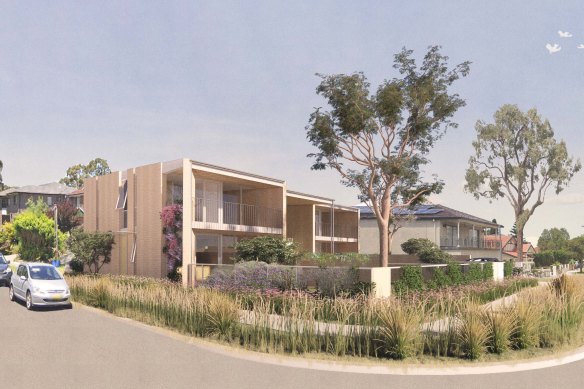
In selecting the sites, the government said it considered public transport frequencies and travel times, critical infrastructure capacity and constraints, local housing targets and distribution, and access to goods and services. Stations and town centres excluded from the scheme could later be added.
Planning and Public Spaces Minister Paul Scully said there had been increasing demand for medium-density housing that was close to public transport hubs, services and infrastructure.
“Allowing low- and mid-rise housing in more locations will help increase the number of homes in our state, improve affordability for renters and buyers and give people a choice on the type of home they want to live in,” Scully said.
Scully said the changes would also “unlock the potential” of the NSW pattern book of designs for terraces and small unit blocks that will attract a faster approval process for developers and builders.
Urban Taskforce chief executive Tom Forrest said the government had stepped back from the initial scope of the reforms, and the decision to limit the changes to residential zones was a “big and very disappointing change” which “effectively pushes housing further away from transport nodes – the opposite of the [Transport Oriented Development] policy”.
“The number of designated town centres and rail station sites that the policy will apply to is considerably smaller at 171 – there are 306 heavy rail stations on the electrified rail network alone – let alone bus corridors, light rail stops, metro stops and other town centres.”
Urban Development Institute of Australia chief executive Stuart Ayres this week said uncertainty over stage two of the medium density reforms in the past 14 months had meant the “heavy lifter of housing reform is now looking more like a handbrake on new housing”.

Stay in Touch
Sign up for FOKE E-News HERE
info@foke.org.au
https://www.facebook.com/friendsofkuringgai/