
CASE STUDY: Gordon Railway Station
Will Gordon Railway Station be able to cope with the mandatory additional 9,500 dwellings without compromising its heritage>
Will the population increase will overwhelm the infrastructure capacity for the number of people travelling from Gordon Railway Station the railway line and undermine its heritage?

Gordon Railway Station
LINK HERE
All Addresses
Statement of Significance
Gordon Railway Station Group is significant at a state level as an excellent representative example of an early 20th century suburban station building group located on the North Shore line, which retains a high degree of integrity and quality in its architectural detail. The station group demonstrates the importance of the role of the railway in opening up the areas of the northern suburbs of Sydney for settlement at this time. It is able to evoke an earlier era of rail travel through its grouping of the original Platform 2/3 station building, platforms and booking office, along with sympathetic later additions.
The station contributes to the cohesive character of the North Shore line, characterised by its early 20th century railway architecture, generally in landscaped settings, which demonstrates the rapid construction of this section of the rail network. Gordon station stands out in the North Shore group of stations, due to its overhead booking office, which is an unusual feature in this region.
Date Significance Updated : 26/10/2010
Note: The State Heritage Inventory provides information about heritage items listed by local and State government agencies. The State Heritage Inventory is continually being updated by local and State agencies as new information becomes available. Read the Departments copyright and disclaimer.
Assessment of Significance
SHR Criteria a) Historical Significance
Gordon Railway Station is historically significant at a state level. Opened in 1890, Gordon Station was one of the first stations along the North Shore line, and demonstrates the role of the railway in facilitating the rapid subdivision and development of the northern suburbs of Sydney. The elements that contribute to this significance include the 1909-1910 station building, booking office, overhead walkway, and platforms.
SHR Criteria c) Aesthetic Significance
As a complex, Gordon Railway Station is of state aesthetic significance as a fine example of an early 20th Century railway station along the North Shore line, which retains a high degree of integrity and quality of detail. The elaborate nature of its architectural detail is perhaps indicative of the importance of Gordon Railway Station as an early intermediate terminus along the North Shore line. This station building contributes to the cohesive group of 20th century railway architecture which is characteristic of the northern section of the rail network, and demonstrates the rapid historical construction of the North Shore line. The reconstructed waiting room contributes to the general early 20th century character of the Gordon Railway Station, and is a physical record of one the earliest structures at the station, although in itself it has little heritage value.
SHR Criteria d) Social Significance
Gordon Railway Station has social significance as evidenced by the community involvement during the design and construction of the new lifts and access arrangements. Local historical societies are also known to include the station complex in historical tours of the local area, thereby demonstrating the high esteem held by particular members of the community for the Gordon Railway Station.
SHR Criteria f) Rare Assessment
The location of the booking office on the overbridge is rare along the North Shore line, which is perhaps indicative of the importance of Gordon Railway Station as an early terminus along this line.
SHR Criteria g) Representative Assessment
Gordon Railway Station is of representative significance at a state level as an early 20th century railway station complex. Elements that contribute to this significance include the 1909 station building, overbridge and platforms. The footbridge is a good representative example of such structures, of which 28 were constructed in Metropolitan Sydney, with a number still remain within the metro network. The brick station building on the island platform is a good and intact representative example of early 20th century station building constructed along the North Shore line.
Integrity/Intactness
The station group retains a high level of integrity, with sympathetic modern additions.
Assessment Criteria
Items are assessed against the State Heritage Register to determine the level of significance.
Description
Designer/Maker: New South Wales Department of Railways
Builder/Maker: New South Wales Department of Railways
Construction Year Start & End: 1909-1909
Physical Description
CONTEXT
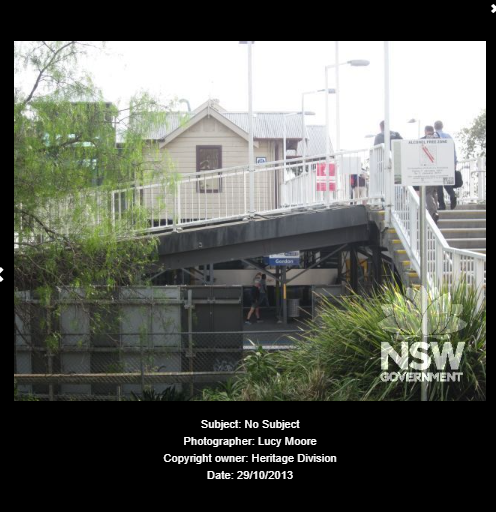
Gordon Railway Station is located east of the Pacific Highway at Gordon. The station complex includes three platforms; an early 20th century overhead walkway and booking office with modern lift towers on the northern side; an early 20th century station building on an island platform; a reconstructed late 19th century timber waiting room; and an easement approximately 10m wide on either side of the railway tracks, which has been landscaped. The station is accessed via modern stairs and disabled ramp from either side of the station. There is a commercial strip on the western side of the Pacific Highway immediately across the road from the station.
LANDSCAPE SETTING
Both the eastern and western lengths of the rail corridor are landscaped with several mature trees and shrubs including poplars, jasmine, jacaranda, palms, agapanthus, camellias and lawned areas.
STRUCTURES
Footbridge (1909)
Platforms (1909)
Modern Steel Shelters
BUILDINGS
Station Building, including Signal Box, Platform 2/3 (c.1909)
Overhead Booking Office (1910)
Station Building, Platform 1 (1993)
STATION BUILDING (c1909)
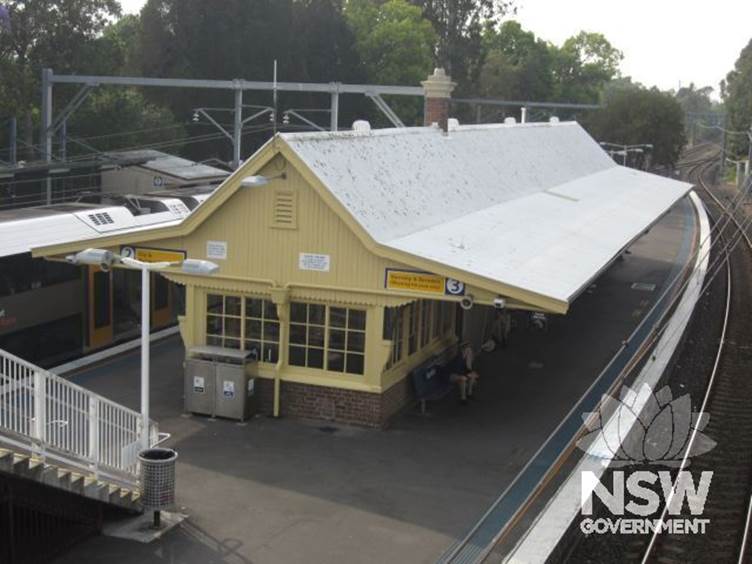
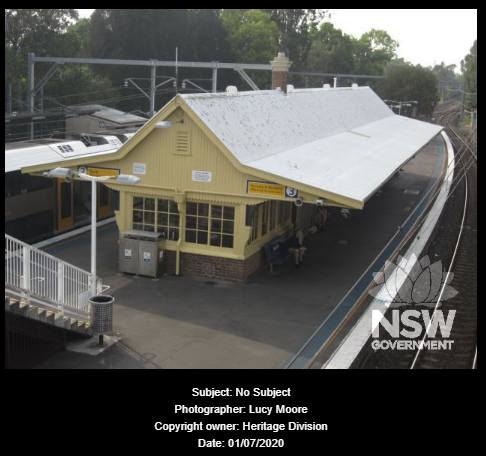
Exterior: Located on the island platform (Platform 2/3) the station building (c.1909) is a good representative example of the standard railway design A8-A10 station buildings along the Northern line. Walls are red face brick, tuck pointed with moulded rendered string course, architraves and window sills. The gabled roof is modern corrugated steel, and the ends are timber boarded. The lower pitched awnings over the platform are supported on cast iron awning brackets springing from moulded rendered corbels. One face brick chimney with rendered top is sited along the ridge line. At the northern end of the building is located a brick signal box with encircling sliding 6-paned windows on three sides under the main roof line. The exterior of the station is largely in original condition, with no additional openings or infilled elements.
Interior: The interior of the Platform 2/3 station building contains a high degree of original fabric and layout. Original internal details include mini-orb ceiling, ceiling roses, plastered wall finishes with moulded dado, and door and window joinery including 16-paned coloured glass sashes. The floor has been replaced with concrete, and modern fluorescent lighting installed. The interior of the signal box is painted brick to window sill height and timber boarded above the windows, with a mini orb ceiling and timber floor. Fittings include the 28 lever frame, key box, 1927 Indicator board, 1969 indicator board, original timber desk and bells.
OVERHEAD BOOKING OFFICE (1910)
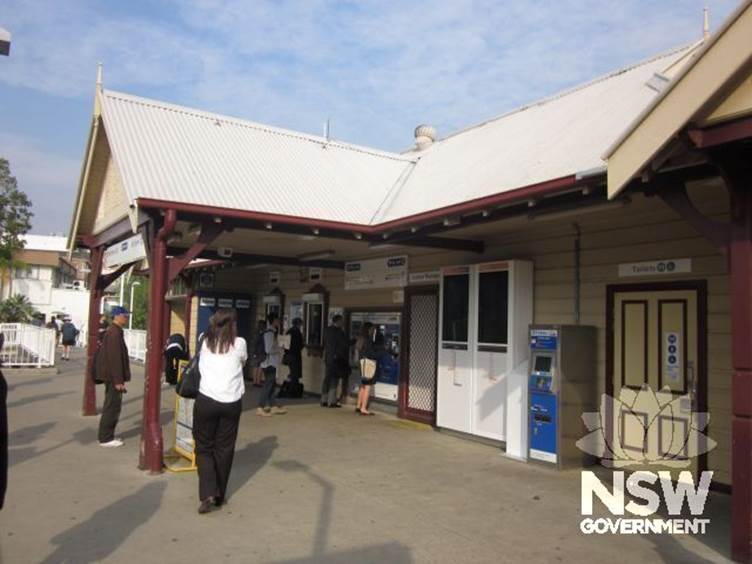
Exterior: The timber framed and weatherboard clad booking office was constructed in 1910 and located on the overhead platform. It has a gabled roof of modern corrugated iron steel with finials. The roof overhang and projecting gable on the southern side provides a sheltered area for ticket purchasing, and features timber boarded ceiling and rose. Two modern ticket windows have been inserted into original openings with decorative timber architraves remaining. Other modern ticket machines have been recessed into the building in new openings with profiled timber architraves. Two new steel and glass lifts are located on the north side of the building and overbridge. New access structures to these lifts have been constructed in a similar style and material to the original booking office, and feature coloured glass panels. The lift access structure on the eastern side includes two small commercial tenancies, only one of which is presently occupied.
Interior: Internally the original layout of the building appears to have been largely altered. Timber panelled wall linings appear original, although the battened plaster ceiling is not. Air-conditioning ducts and fluorescent lights are modern. Doors are timber panelled and windows are 4 or 6-paned sash, which all appear to be original.
STATION BUILDING (1993)
A small timber framed structure reconstructed in 1993 based on the design of the original 1890 waiting room. The structure is clad externally with timber weatherboards and has a skillion roof of corrugated steel. The structure is open with exposed framing, concrete floor and timber bench.
FOOTBRIDGE (1909)
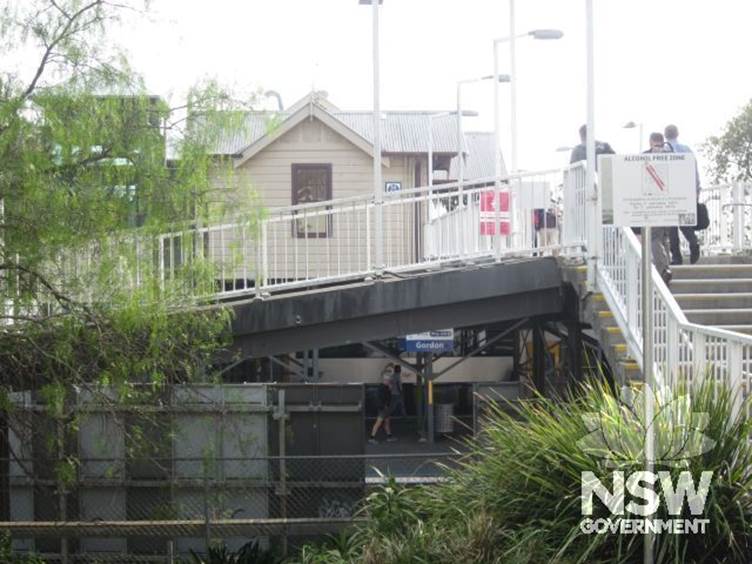
Dating from 1909 the footbridge has a steel haunched beam construction supported on steel trestles. The two bay structure spans two tracks on the eastern side and one track on the western side of the rail corridor. Markings of imported British steel manufacturers are visible, both Lanarkshire, and Dorman Long & Co., Middlesborough. The concourse has a concrete deck and modern steel balustrades. Modern concrete steps on steel supports provide access to the island platform. Similar steps and disabled ramp provide access to the streets on either side of the station.
PLATFORMS (1909)
The island platform (Platform 2/3) at Gordon was built in 1909 as part of the line duplication for the Northern line, and has brick faces and an asphalt platform surface. The overhead booking office and footbridge are located approximately at the half way point of the platform, with the station building located at the southern end. Platform 1 also has brick faces and an asphalt surface and is likely to date from the same period.
MODERN STEEL SHELTERS
As part of the upgrading of the station in which lifts were installed, steel framed shelters were installed at the northern end of both platforms.
MOVEABLE
1914-1918 Honour Roll (Overhead Platform)
1927 and 1969 timber indicator boards still in use (Overhead Platform)
Cast iron drinking fountain (Platform 2/3)
Physical Condition and/or Archaeological Potential
Overhead Booking Office – Good Condition
Station Building (Platform 2/3) – Good Condition
Station Building (Platform 1) – Good Condition
Footbridge – Good Condition
Platforms – Good Condition
Landscape – Good Condition
Modern Steel Shelters – Very Good Condition
Archaeological Potential – Low
Modifications & Dates
1927: Electrification of the North Shore line between Milson’s Point and Hornsby was opened on 15 August 1927.
1928: Full electric services were provided 15 July 1928, and included services at Gordon. With electrification came automatic signalling and most signal boxes were closed. However, Gordon Signal Box remained in service until recent years (as with other North Shore signal boxes including North Sydney, Chatswood, Lindfield) due to the need for local control of terminating trains. When the principal signal control centres were opened at Sydney and Hornsby, these local signal boxes were closed, including Gordon. With electrification of the North Shore line, a relatively small 1500V. D.C. substation was built adjacent to the down North Shore line at Gordon.
1990s: The former Gordon substation was replaced by a modern D.C. substation on the opposite side of the line and the original substation building (brick) was demolished.
N.d: Some relatively modern additions such as shelters / awnings have been provided on the island platform.
Current Use: Railway Station
Former Use: Aboriginal land, farm, timber-getting
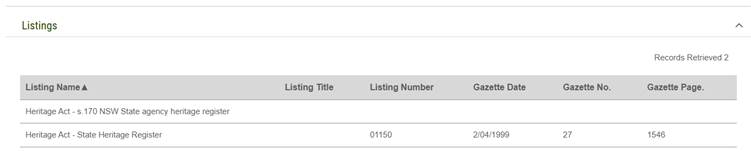
Listings
History
In 1887, tenders were called for construction of a branch line extending south from Hornsby to the North Shore. The 16.8km section between Hornsby and St. Leonard’s was opened on 1 January 1890. Stations provided at the opening of the line included Chatswood and St. Leonard’s. A single line was constructed at the time. The line between St. Leonard’s and Milson’s Point (the terminus at the edge of the harbour) was completed 1 May 1893.
Gordon Railway Station was opened on 1 January 1890. In 1909 the single line was duplicated between Hornsby and St. Leonard’s. At Gordon, during the duplication the original single platform and station building were replaced by a new island platform with a standard brick island-platform style station building. The island platform served the Up North Shore line and the Down North Shore line. A third platform was built at Gordon (the Local Platform) adjacent to the Up line. This platform allowed for termination of local trains at Gordon. At the time of duplication, an overhead footbridge and booking office was built which allowed local residents to cross from one side of Gordon to the other and allowed access to the platforms via sets of steps.
A goods siding (adjacent to the Down line), crossovers and a signal box on the platform (part of the station building) completed the track arrangement.
Richard Henry (R.H.) Patterson took up the position of Assistant Building Inspector at Ku-ring-gai Shire (later, Municipal) Council in 1926. By 1927 he was promoted to the position of Building Surveyor and Parks Superintendent, under Shire Engineer, Lionel Price. Patterson became the ‘driving force’ behind Council’s park development and beautification program… He placed greater emphasis on the use of native species… (for street tree planting). He nonetheless also used exotic species, for example to beautify the railway station gardens in Ku-ring-gai (James, 2015, 71, 73, 74).
Historic Themes
Records Retrieved 24
| Australian Theme | New South Wales Theme | Local Theme |
| 1. Environment | Environment – naturally evolved | Parks |
| 1. Environment | Environment – naturally evolved | Other open space |
| 1. Environment | Environment – naturally evolved | Modification of terrain |
| 1. Environment | Environment – naturally evolved | Introduce cultural planting |
| 1. Environment | Environment – naturally evolved | Changing the environment |
| 3. Economy | Transport | Railway Station |
| 3. Economy | Transport | Building the railway network |
| 3. Economy | Events | Developing local landmarks |
| 3. Economy | Environment – cultural landscape | Landscapes of urban amenity |
| 3. Economy | Environment – cultural landscape | Landscapes of institutions – productive and ornamental |
| 3. Economy | Environment – cultural landscape | Landscapes and parklands of distinctive styles |
| 3. Economy | Environment – cultural landscape | Developing local, regional and national economies |
| 4. Settlement | Land tenure | Resuming private lands for public purposes |
| 4. Settlement | Land tenure | Changing land uses – from rural to suburban |
| 4. Settlement | Land tenure | Administering and alienating Crown lands |
| 4. Settlement | Accommodation | Building settlements, towns and cities |
| 4. Settlement | Accommodation | A Picturesque Residential Suburb |
| 5. Working | Labour | Working on public infrastructure projects |
| 5. Working | Labour | Working in the public service |
| 5. Working | Labour | Railway work culture |
| Governing | Government and Administration | State government |
| 7. Governing | Government and Administration | Developing roles for government – building and operating public infrastructure |
| 7. Governing | Government and Administration | Developing roles for government – building and administering rail networks |
| 8. Culture | Creative endeavour | Applying architectural design to utlilitarian structures |
Recommended Management
Recommended Management
Records Retrieved 3
| Management Type | Date Updated |
| Recommended Management – Carry out interpretation, promotion and/or education | 7/02/2024 |
| Recommended Management – Prepare a maintenance schedule or guidelines | 7/02/2024 |
| Recommended Management – Review a Conservation Management Plan (CMP) | 7/02/2024 |
References and Internet Links
Records Retrieved 3
| Type | Author | Year | Title | Link |
| Written | James, Dr. Peggy | 2015 | The Life and Works of Richard Henry Patterson | |
| Tourism | Attraction Homepage | 2007 | Gordon Railway Station group | View Details |
| Written | Sheedy, David | 2002 | Conservation Management Plan – Gordon Railway Station |
Data Source
The information for this entry comes from the following source:
Data Source: State Government
Record Owner: Heritage NSW
Heritage Item ID: 5012021
Every effort has been made to ensure that information contained in the State Heritage Inventory is correct. If you find any errors or omissions please send your comments to the heritagemailbox@environment.nsw.gov.au
All information and pictures on this page are the copyright of Heritage NSW or respective copyright owners. The State Heritage Inventory is continually being updated by local and State agencies as new information becomes available. Read the Department of Planning and Environment Copyright and Disclaimer.


Quick View
Listing Type: SHR #01150
Primary Address: Middlemiss Street GORDON NSW 2072
Local Govt. Area: Ku-Ring-Gai
Local Aboriginal Land Council: Metropolitan
Type of Item: Complex / Group
Group/Collection: Transport – Rail
Item Category: Railway Platform/ Station